
How to Search Leon County Court Records
Leon County court records are searched through the online services of the Leon County Clerk of the Circuit Court and Comptroller. The clerk runs two main case search routes. One searches by party name. The other searches by exact case number. Both cover circuit and county court matters, and most case types show up in the public docket. Some images and case types are held back, which the clerk explains on its records pages.
Before you start, get a few things ready. Have the full name or the case number in hand. Know the rough year the case was filed. A case number gives the cleanest result, so use it first when you have it.
- Open the clerk's court search portal and pick search by name or search by case number.
- Enter the party name or the exact case number as it appears on your notice or filing.
- Narrow the search by court type, case type, or a date range when the portal offers it.
- Read the case summary first, then open the progress docket to see filings, orders, and hearings.
- Order an e-certified copy if the document is eligible, or file a record request when an image is not shown online.
The Second Judicial Circuit also posts court services, calendars, and self-help links for Leon County users. A look at the circuit's overview helps first-time visitors see how the courts, the clerk, and the county fit together.
The clerk and the circuit keep separate public pages, and both matter for a full Leon County court records search. You can read more about each search route on the court records and court dockets pages.
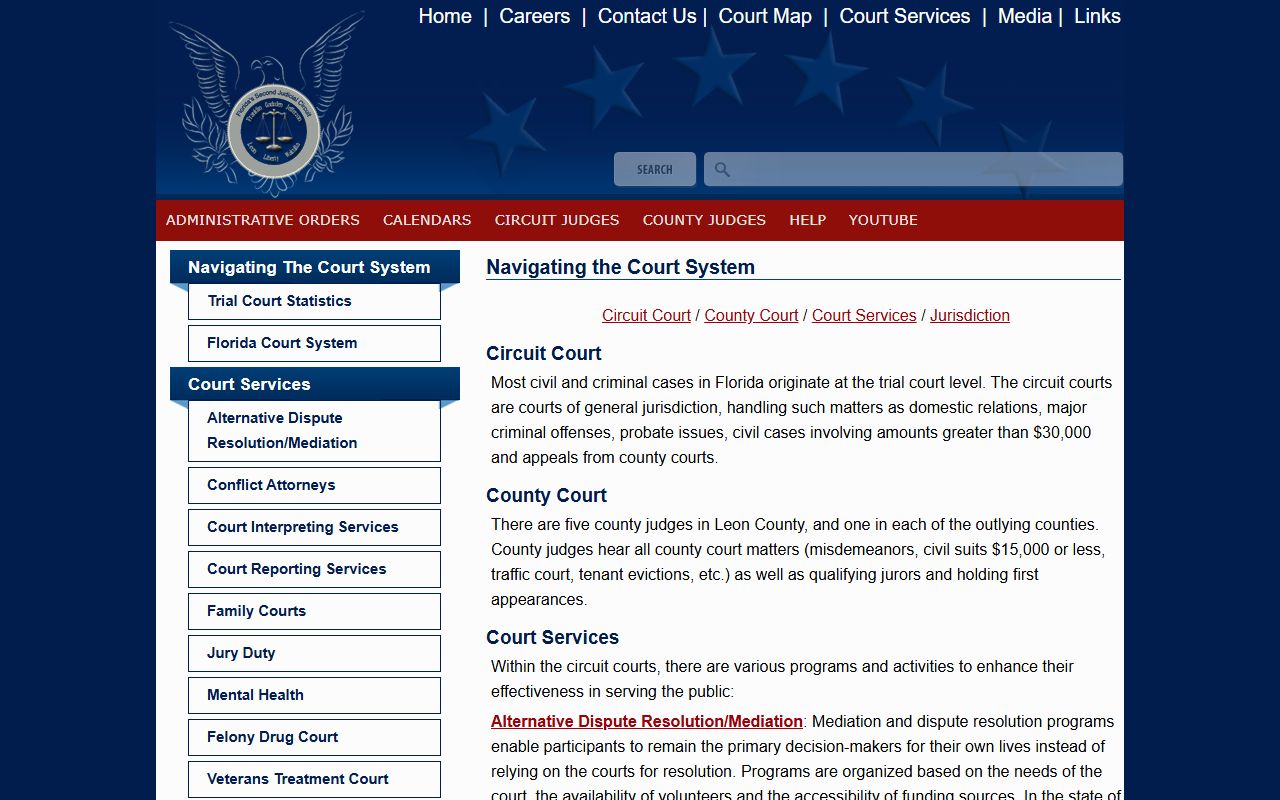
The circuit's court-system page lists circuit court, county court, mediation, interpreters, family courts, and specialty programs in one place, which is a good starting map for any records search.
Leon County Court Records Search Fields
The clerk's search by name page uses a small set of fields. You do not need every box filled. A last name plus a court type often does the job. The table below lists the fields seen on the public name search and how each one is used.
| Field Label | Type | Required | Notes / Format |
|---|---|---|---|
| Last Name / Business Name | Text | Yes for name search | Party last name or business name. |
| First Name | Text | Optional | Used for individual parties. |
| Middle Name / Initial | Text | Optional | Helps narrow common names. |
| Court Type | Dropdown | Optional | Civil, criminal, family, probate, traffic. |
| Case Type | Dropdown | Optional | Restricts the search within a court type. |
| Begin / End Date | Date | Optional | Use MM/DD/YYYY format. |
When you search by case number instead, the form is shorter. You enter the exact clerk case number and, if asked, the court type or division. Florida case numbers often include the year, a division code, and a sequence number, so copy the number as printed.
The Leon County Judicial System
Florida uses a two-tier trial court system, and Leon County sits inside it. The trial courts are the circuit court and the county court. Above them are the District Courts of Appeal and the Supreme Court of Florida. Leon County is part of the Second Judicial Circuit, which also serves Franklin, Gadsden, Jefferson, Liberty, and Wakulla counties. Appeals from Leon trial courts head to the First District Court of Appeal.
The circuit court is the general trial court. It hears felonies, family law, probate, guardianship, juvenile matters, and larger civil disputes. The county court is the limited court. It hears misdemeanors, traffic, evictions, small claims, and first appearances. The Second Judicial Circuit reports 16 circuit judges in the Leon section, led by Chief Judge Frank Allman, plus five county judges in Leon County.
Case flow: County Court › Circuit Court › First District Court of Appeal › Supreme Court of Florida
| Court | Jurisdiction | Case Types |
|---|---|---|
| Supreme Court of Florida | Highest court, statewide | Discretionary review, death-penalty appeals, attorney and judicial discipline |
| First District Court of Appeal | Intermediate appeals | Most appeals from circuit and county court orders |
| Circuit Court (Second Circuit) | General jurisdiction | Felonies, family, probate, guardianship, juvenile, civil over $50,000 |
| County Court | Limited jurisdiction | Misdemeanors, traffic, evictions, small claims, first appearances |
The split between the two trial courts decides where a case is filed and where its records live. The table below compares them side by side so you know which court to search first.
| Feature | Circuit Court | County Court |
|---|---|---|
| Criminal cases | Felonies | Misdemeanors |
| Civil cases | Disputes over $50,000 | Disputes up to $50,000 |
| Family and probate | Divorce, probate, guardianship, juvenile | Not handled here |
| Traffic and evictions | Not handled here | Traffic, small claims, evictions |
| Judges in Leon County | 16 circuit judges | 5 county judges |
For a deeper look at each level, see the Leon County Circuit Court and Leon County County Court pages.
Leon County Courthouses
The main court building is the Leon County Courthouse at 301 South Monroe Street in downtown Tallahassee. It is the public center for circuit and county court filings, first appearances, jury service, hearings, clerk services, and court record access. The clerk also runs a Northeast Branch on Metropolitan Boulevard for some payments, official records, and marriage services.
First appearances for people booked into the county jail are held in courtroom 2D. They start at 11:00 a.m. on weekdays and 8:00 a.m. on weekends and holidays. The addresses and phone lines below cover the courthouse and the clerk's branch.
Leon County Courthouse
301 South Monroe Street
Tallahassee, FL 32301
850-577-4000
Clerk Northeast Branch
1276 Metropolitan Boulevard, Room 101
Tallahassee, FL 32312
850-606-4100
Second Judicial Circuit
301 South Monroe Street
Tallahassee, FL 32301
850-606-4401
Types of Court Records Available in Leon County
Leon County court records fall into a handful of broad groups. Each group is tied to a court division and a set of case types. Felony files sit in circuit court. Misdemeanor and traffic files sit in county court. Family, probate, and juvenile matters are circuit court divisions. Most dockets are public, but some documents are limited by rule or statute.
The list below shows the main record types and where they come from.
- Criminal records - felony cases in circuit court and misdemeanors in county court, with arrest affidavits, charges, pleas, and judgments.
- Civil records - complaints, motions, judgments, and liens from circuit civil and county civil cases.
- Family and divorce records - dissolution, paternity, child support, and injunction files in the family division.
- Probate records - wills, estates, guardianship, and incapacity files maintained by the clerk.
- Traffic records - citations, school elections, payments, and dispositions from county traffic court.
What Leon County Court Records Show
A Leon County court record is more than a single page. It is a running file built from each filing, order, and hearing. Online, you usually see a case summary first, then a progress docket that lists events in date order. Some events link to document images when those are public. The table below shows the fields you are most likely to read on a public case.
| Field | What It Shows |
|---|---|
| Case Number | The clerk's unique case identifier, formatted by division and year. |
| Filing Date | The date the first document was filed with the clerk. |
| Parties | Plaintiff and defendant, or petitioner and respondent, unless confidential. |
| Charges / Cause | The criminal charge and statute, or the civil cause of action. |
| Disposition | The current or final outcome, such as dismissed, guilty, or judgment entered. |
| Sentence / Judgment | The penalty or the money judgment ordered by the court. |
Names of attorneys, hearing dates, courtrooms, and financial obligations may also appear. Sensitive details are redacted under Florida rules.
Public Access Laws for Leon County Court Records
Florida has one of the broadest public records laws in the country, but access to court files follows its own track. General agency records open under Chapter 119. Judicial branch records open under a separate court rule that lists what stays confidential and sets the steps to seal a record. The clerk's records pages carefully split court records, official records, and other public records, because each follows different rules.
A few key laws shape what you can see and what you must pay. They are linked below in plain terms.
Key Statutes:
Florida Statutes § 119.01 - sets the state policy that public records are open for inspection and copying by any person.
Florida Statutes § 119.07 - covers the right to inspect and copy records and the fees an agency may charge.
Florida Statutes § 119.0714 - addresses court files, court records, and protected details kept off the web.
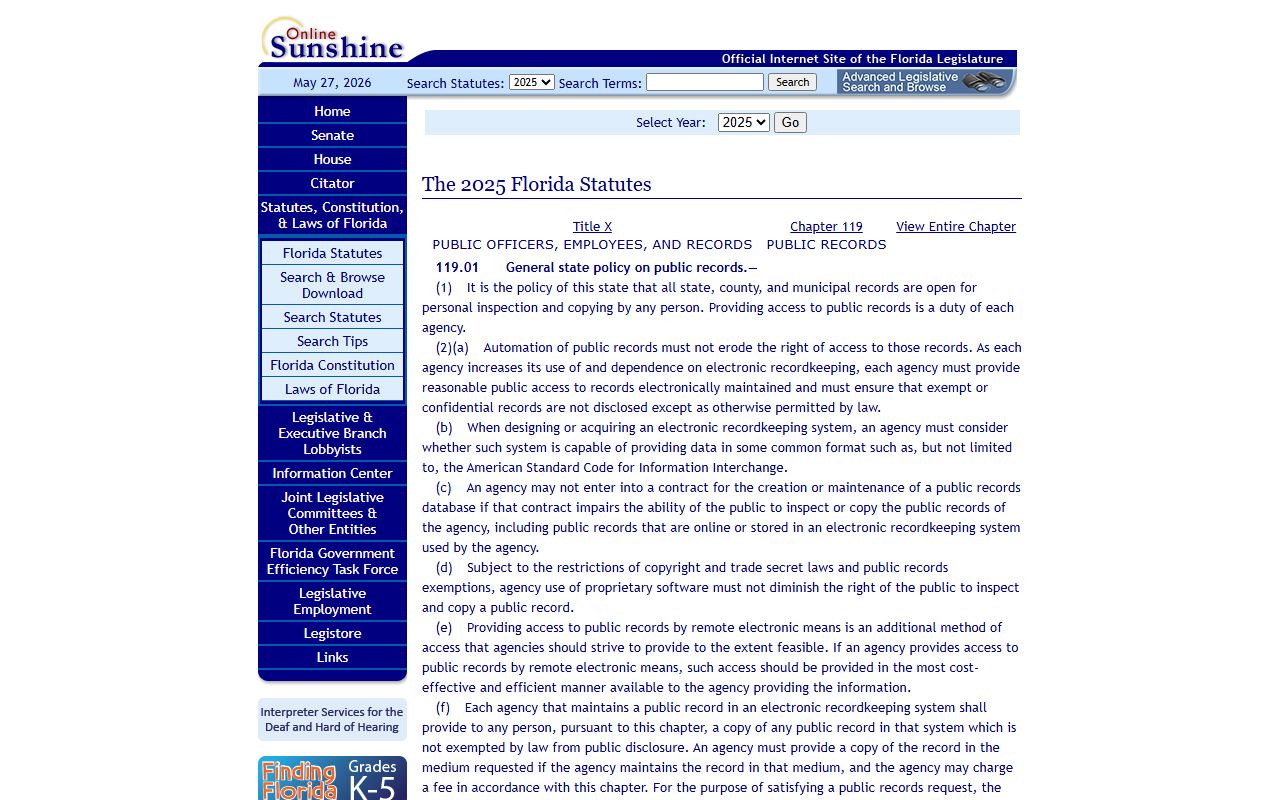
Section 119.01 is the starting point for most Leon County public records outside the courts, while judicial records stay under the court access rule.
Records That Are Restricted or Confidential
Not every Leon County court record is open. Florida law and court rules wall off whole categories. Juvenile dependency and delinquency files are restricted. Adoption records are confidential and need a court order to view. Sealed and expunged criminal records drop out of public access once a judge signs the order. Mental health and incapacity files carry medical privacy limits.
The clerk's e-certify page also lists case types it will not certify online, such as sealed, expunged, hidden-from-web, dependency, delinquency, guardianship, mental health, and active-process criminal cases. If you believe a record should be open, the path is a motion under the court access rule. A judge decides whether the file or a part of it can be released. The public records page explains the request process in more detail.
Specialty Courts in Leon County
Leon County runs several problem-solving courts. These programs aim at treatment and accountability rather than a simple sentence. The county's Felony Drug Court started in 1993 and is described as the country's third pre-adjudicatory felony drug court. It is a partnership among the court, the State Attorney, the Public Defender, the county, state probation, and treatment providers. Fees run $95 per month, and the program usually lasts 12 to 18 months.
Veterans Treatment Court began in 2015 for eligible veterans and service members with service-related conditions. The Second Circuit also runs Mental Health Court resources and a heavily used Teen Court diversion program for juveniles.
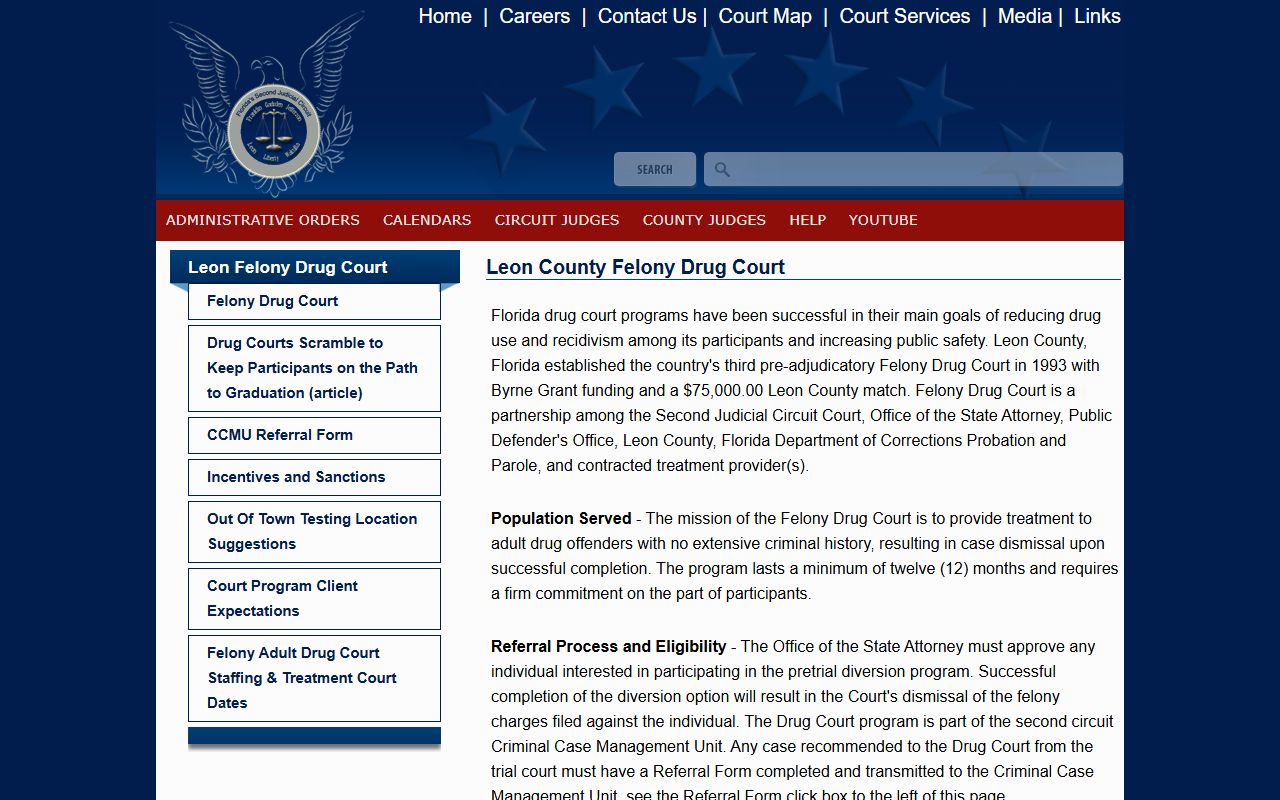
The official Felony Drug Court page lays out eligibility, fees, and the coordinator contact, and it shows how specialty court records differ from a standard criminal case file.
Leon County Sheriff and Jail
The Leon County Sheriff's Office is led by Sheriff Walt McNeil. The agency runs the Leon County Detention Facility on Appleyard Drive, which books people for every law enforcement agency in the county. The jail opened in late 1993 with capacity for 1,219. The sheriff posts an online inmate search that shows current custody, charges, arrest dates, and the arresting agency.
Jail booking data is not the same as a court outcome. The sheriff's own disclaimer says the inmate search is for information only and does not reflect final disposition. For the full roster and visitation details, see Leon County inmate records. For active warrants, see the warrant records page.
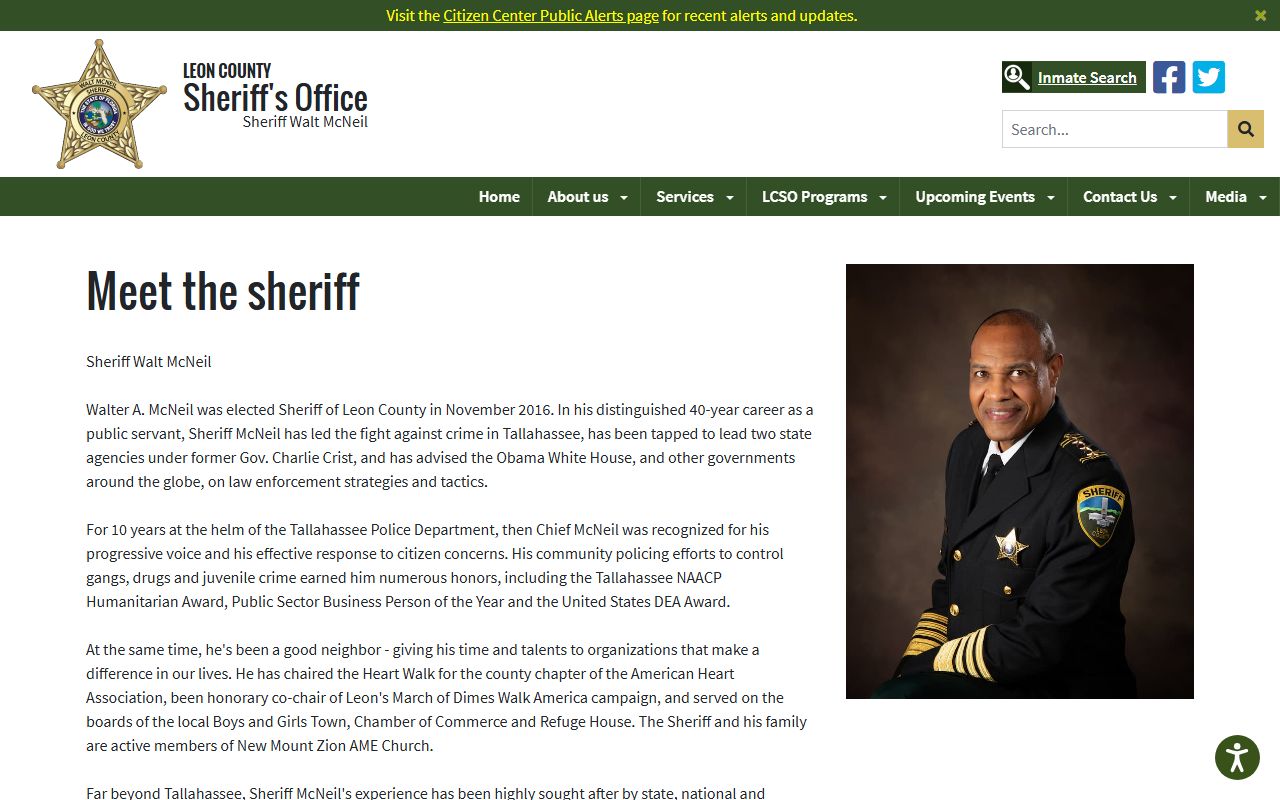
The sheriff's office page is the official gateway to the detention facility and the inmate search tools that pair with county court records.
Marriage, Divorce, and Probate Records
The clerk handles marriage licenses, keeps divorce files as family-law cases, and maintains probate files for the Probate Division of the Circuit Court. Marriage license fees are $86, or $61 when both Florida residents finish a qualifying premarital course. Summary probate administration may be filed when an estate is worth $75,000 or less, or when the person has been dead for more than two years. See marriage and divorce records and probate records for the full steps.
Probate has its own vocabulary. A short glossary helps when you read an estate or guardianship docket.
- Testator
- The person who made the will.
- Personal representative
- The person appointed to settle the estate, sometimes called the executor.
- Intestate
- Dying without a valid will, so state law decides who inherits.
- Guardian
- A person appointed to care for a minor or an incapacitated adult.
- Ward
- The person placed under a guardianship.
Leon County Court Records Fees
The clerk charges set fees for searches, copies, and certification. Florida law under Chapter 28 authorizes these service charges. The amounts below come from the clerk's published fee schedule. A yearly search fee applies when staff must search by hand across years.
| Item | Amount |
|---|---|
| Search of records, each year searched | $2.00 |
| Plain copy, per page (up to 14 x 8.5 in.) | $1.00 |
| Certified copy, per document | $2.00 |
| Exemplified certificate | $7.00 |
| Sealing or expunging a criminal record | $66.50 |
Note: The clerk's official fee schedule controls and should be checked before you order, since service charges can change.
How to Interpret Leon County Court Records
Court dockets use shorthand. Learning a few terms keeps you from misreading a case. An arrest is not a conviction. A charge is what the state alleges. A disposition is the outcome. "Nolle prosequi" means the state dropped the charge. "Withhold of adjudication" means the judge held back a formal conviction under conditions. "Dismissed with prejudice" means the case cannot be refiled.
Watch the dates too. A filing date is not a hearing date, and a hearing date is not a final disposition. When a docket entry is unclear, the clerk can explain what a code means, but staff cannot give legal advice. For the full meaning of an outcome, read the order itself or talk to a lawyer.
Accuracy and Record Limitations
Online records lag real time. A new filing, a paid fee, or a signed order may take a day or more to post. Some images are paper-only or held back for review. The jail search shows arrest data, not court results, so the two systems can disagree for a short time.
Note: Confirm any detail that affects rights, money, or a deadline with the clerk or the originating office before you rely on an online record.
History of Leon County Courts
Florida's modern two-tier trial court system grew out of Article V reforms. The Second Judicial Circuit notes that until 1973 Florida had more kinds of trial courts than any state except New York. The late-1960s reforms simplified the structure, and municipal courts were abolished by January 1, 1977. Older Leon County records may still name those former courts.
Leon County sits at the center of Florida government because Tallahassee is the state capital. The courthouse stands near the Capitol, state agencies, and federal court offices. That mix gives the county an unusually dense legal district, from routine traffic cases to state-government litigation.
Frequently Asked Questions
Are Leon County court records public?
Most are public, but access follows Florida's court access rule and confidentiality statutes. You can search many dockets through the clerk. Sealed, expunged, dependency, delinquency, adoption, and mental health records are not shown online.
Who keeps Leon County court records?
The Leon County Clerk of the Circuit Court and Comptroller keeps the records for both circuit and county court. Gwen Marshall is the elected clerk. The same office records official records, issues marriage licenses, and processes traffic payments.
What is the difference between circuit court and county court?
Circuit court is the general trial court for felonies, family law, probate, and larger civil cases. County court is the limited court for misdemeanors, traffic, evictions, small claims, and first appearances.
How do I search a court case?
Use the clerk's court search by name or by case number. A case number gives the cleanest result. By name, use the last name and narrow by court type or date range. Request copies if a document is not shown.
Can I get certified records online?
Yes. Many eligible court and official records can be e-certified through the clerk and are available around the clock. Sealed, expunged, hidden-from-web, and several sensitive case types are excluded from online certification.
How do I find an inmate?
Use the sheriff's inmate search by name. Results show photo, charges, arrest date, jail status, and arresting agency. The search is for information only and is not a background check.
More answers are on the Leon County Court Records FAQ page.