
Gwen Marshall and the Clerk's Role
Gwen Marshall is the Leon County Clerk of the Circuit Court and Comptroller. She was elected on November 8, 2016, and she was the first woman and the first African American elected to that office in the county. Before she ran, she spent 17 years working for the Florida Association of Court Clerks and Comptrollers. That long run gave her a close view of how clerk offices work across the state.
Florida gives this one elected clerk a wide job. The same office supports circuit court and county court, keeps court records, records official records, issues marriage licenses, processes passports, registers domestic partnerships, and runs the county comptroller duties. It also collects court costs, fines, and traffic payments. So when you need a Leon County court file or a certified copy, the clerk is the office you deal with.
Leon County Clerk of the Circuit Court and Comptroller
Clerk: Gwen Marshall
301 South Monroe Street
Tallahassee, FL 32301
850-577-4000
Mon-Fri, 8:00 a.m. to 4:30 p.m.
Court Records at the Leon County Clerk
The clerk is the keeper of court records for both the circuit and county courts of the Second Judicial Circuit. Felony cases, family law, probate, and larger civil suits sit in circuit court. Misdemeanors, traffic, evictions, and small claims sit in county court. The clerk files every pleading, builds the progress docket, and stores the orders a judge signs. You can look up most cases by party name or by exact case number through the clerk's online court search.
Access to court files follows a court rule, not the general public records law. When the clerk acts as part of the judicial branch, access is governed by Florida Rule of General Practice and Judicial Administration 2.420. That rule lists which judicial records are confidential and how a party asks a judge to seal one. Most dockets are open, but some case types stay off the public web. For a full walkthrough of searching by name or case number, see the Leon County court records page.
Registered Secure Web users can reach more sensitive case images when those images exist, such as family law, guardianship, and probate. The public court search shows the docket for most cases, yet an image may be held back for review or redaction. A missing image does not mean a case does not exist.
Official Records and the County Recorder
Beyond court files, the clerk serves as the county recorder. Official Records are a separate system from court cases. They hold recorded deeds, mortgages, liens, satisfactions, final judgments, notices, declarations of domicile, military service documents, and domestic partnership records. This duty comes from Florida Statutes section 28.222, which makes the clerk the county recorder and directs that instruments be recorded in one general series called Official Records.
Electronic access to those records is set by Florida Statutes section 28.2221. Most official record images recorded after January 1, 1945 are available online. Death certificates and military separation papers are protected and stay off the public site. If you are tracing a property chain or a recorded judgment, the Official Records search is the right tool, not the court case search.
Florida Statutes section 28.2221 lays out the rules for putting these official records on the web and which document types must be kept off it.
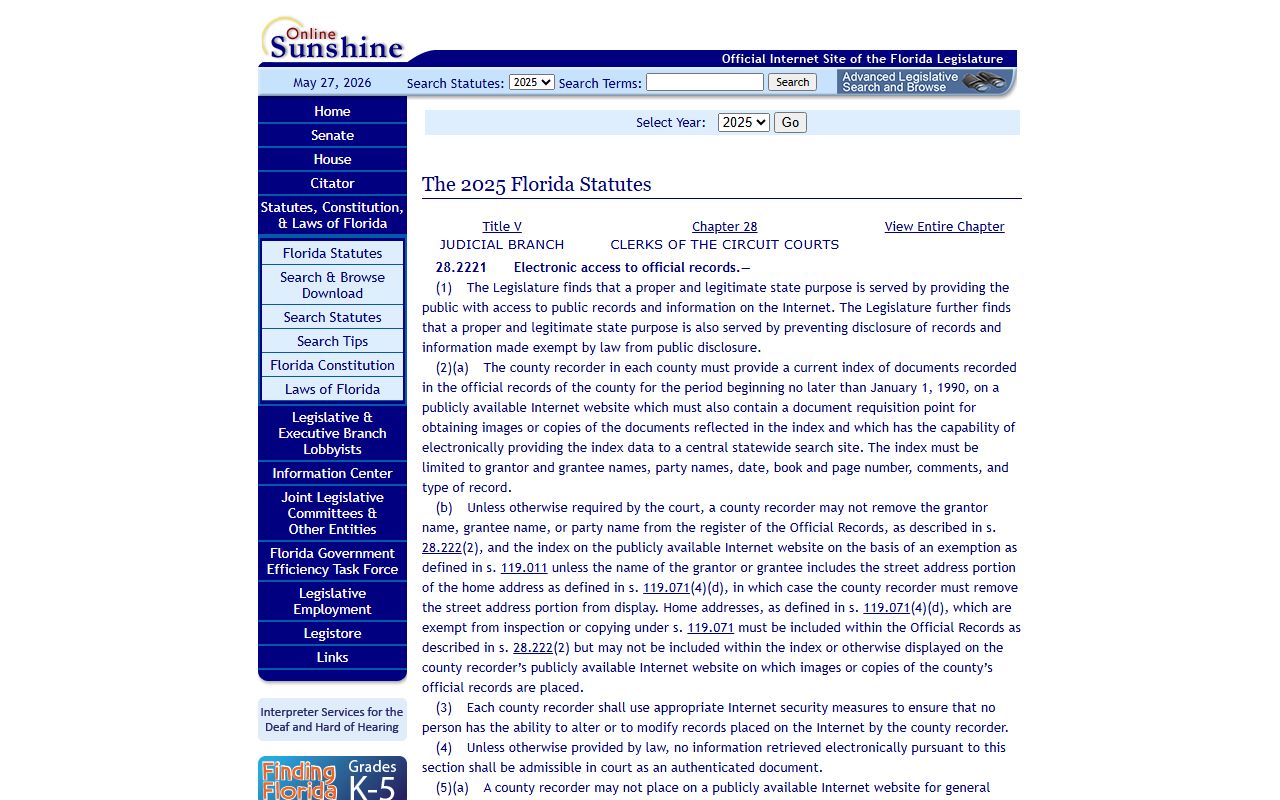
The statute is why the Leon County clerk can post recorded deeds and liens online while it must hold back death certificates and military discharge documents from public view.
Marriage Licenses Through the Clerk
The clerk issues marriage licenses for Leon County. You apply in person, bring valid photo ID, and pay the license fee. Florida has a three-day waiting period for state residents, which a qualifying premarital course can waive. The fee changes with that course. A license without the course is $86.00, and a license with a qualifying premarital course is $61.00. Fees can be paid by cash, check, or credit card.
The clerk also runs a marriage record name search for licenses already on file. Same-sex marriage licenses are issued the same as any other. Once a couple marries, the officiant returns the signed license to the clerk for recording. For divorce files and certified marriage copies, the marriage and divorce records page covers the steps in more detail.
Note: A marriage license has a return deadline after the ceremony, so confirm the current window with the clerk before the wedding date.
Traffic Payments and Citations
County court handles traffic, and the clerk collects the money. You can pay a Leon County traffic citation online, in person, by mail, or by phone. Online payment takes Visa, Mastercard, American Express, Discover, Apple Pay, and Google Pay. A $5 convenience fee applies to e-check, and a 3.5 percent fee applies to other online options. The traffic division phone line is 850-606-4100.
Mailed payments go to the clerk's traffic unit at the Northeast Branch. The clerk also processes school elections and defensive driving affidavits, which can keep points off a record in some cases. Not every citation can be paid online, so check the citation status first. For citation lookups, court handling, and the split between a court record and a state driver record, see the traffic court records page.
Probate Filings and Estates
Probate is handled in the Probate Division of the Circuit Court, and the clerk holds the case files. Probate is the legal process of passing a person's assets to heirs after death. The clerk accepts petitions for formal administration, summary administration, guardianship, and determinations of incapacity. Summary administration may be filed when the estate value is $75,000 or less, or when the person has been dead more than two years.
Filing fees vary by case type. A summary administration of $1,000 or more is $345.00, and one under $1,000 is $235.00. Guardianship of the person only is $235.00, and a petition for determination of incapacity is $231.00. Guardianship and incapacity files may carry privacy limits. For how to search estate cases and read the docket, see the probate records page.
E-Certify for Court and Official Documents
The clerk's e-certify service lets you buy certified court and official documents online, 24 hours a day, seven days a week. Each e-certified document is secure, tamper-proof, and verifiable. It carries a unique reference so a court, agency, or business can confirm it is real. For many uses it works like a traditional certified copy you would pick up at the counter.
Not every record can be certified online. The clerk excludes a set of sensitive and protected case types. A plain download or a screenshot is not certified and may be refused for court, licensing, or title use. Review a document for accuracy before you buy, because refunds are not issued once certification is finished. These case types are excluded from e-certification:
- Sealed, expunged, and hidden-from-web records.
- Wills deposited for safekeeping.
- Adoption cases.
- Criminal cases with an active process.
- Dependency, delinquency, guardianship, and mental health cases.
- Civil traffic infractions and non-case items.
If a document you need sits on that list, request a traditional certified copy from the clerk or use the public terminals at the courthouse. When an image is not online at all, you can submit a record request after checking the docket entry on the progress docket.
How to Request a Certified Copy
A certified copy carries the clerk's seal and proves a document is a true copy of what is on file. Courts, banks, title companies, and other agencies often will not accept an uncertified printout. The steps below cover a standard request, whether you want a court document or a recorded official record.
- Find the case number or the book and page for an official record, then confirm the exact document you need on the progress docket or official records index.
- Choose your route. Use e-certify for an eligible document online, or fill out a records request for items that are not online or not eligible for e-certification.
- Give your contact details for delivery. Florida law does not require special wording, but the clerk needs a way to reach you and send the copy.
- Pay the copy and certification fees. A certified copy is $2.00 per document, plus $1.00 per page for a plain copy and $3.50 per page to verify a document presented for certification.
- Pick the copy up at the counter, or wait for mail or electronic delivery. Review it before you leave, since refunds are not given once certification is done.
For an out-of-state or international use, you may need an exemplified certificate, which the clerk provides for $7.00. Ask the receiving agency what level of certification it requires before you order.
Records Request Form Fields
The clerk does not make you use a single set form for every request, but a complete request moves faster. Include enough detail for staff to find the record and a way to send it back. The table lists the fields a typical court or official records request uses.
| Field | Required | Notes |
|---|---|---|
| Requester name | Yes | Who is asking for the record. |
| Contact information | Yes | Phone, email, or mailing address for delivery. |
| Case number / book-page / document ID | Strongly recommended | Helps staff locate a court or official record fast. |
| Case or document type | Yes | Court case, official record, or general public record. |
| Party names | Optional | Used when you search by name instead of number. |
| Date or year range | Optional | A search fee applies per year searched. |
| Copy type and delivery | Yes | Plain, certified, or exemplified; pickup, mail, or electronic. |
The access-denied screen on the public records request page can block automated lookups, so a quick call to the clerk confirms the current form labels. Payment is required up front for paid copies.
Fees and Branch Locations
The clerk charges set service fees under Chapter 28 of the Florida Statutes. A search fee applies per year when staff search by hand. Copies are priced per page, and certification carries its own charge. The amounts below come from the clerk's published schedule, which controls and can change.
| Item | Amount |
|---|---|
| Search of records, each year searched | $2.00 |
| Plain copy, per page (up to 14 x 8.5 in.) | $1.00 |
| Oversized copy, per page | $5.00 |
| Certifying copies, per document | $2.00 |
| Verifying a document for certification, per page | $3.50 |
| Exemplified certificate | $7.00 |
| Sealing or expunging a criminal record | $66.50 |
| Sealing a civil record | $42.00 |
These service charges trace back to Florida Statutes section 28.24, which sets the clerk's charges for searches, copies, and certification across the state.
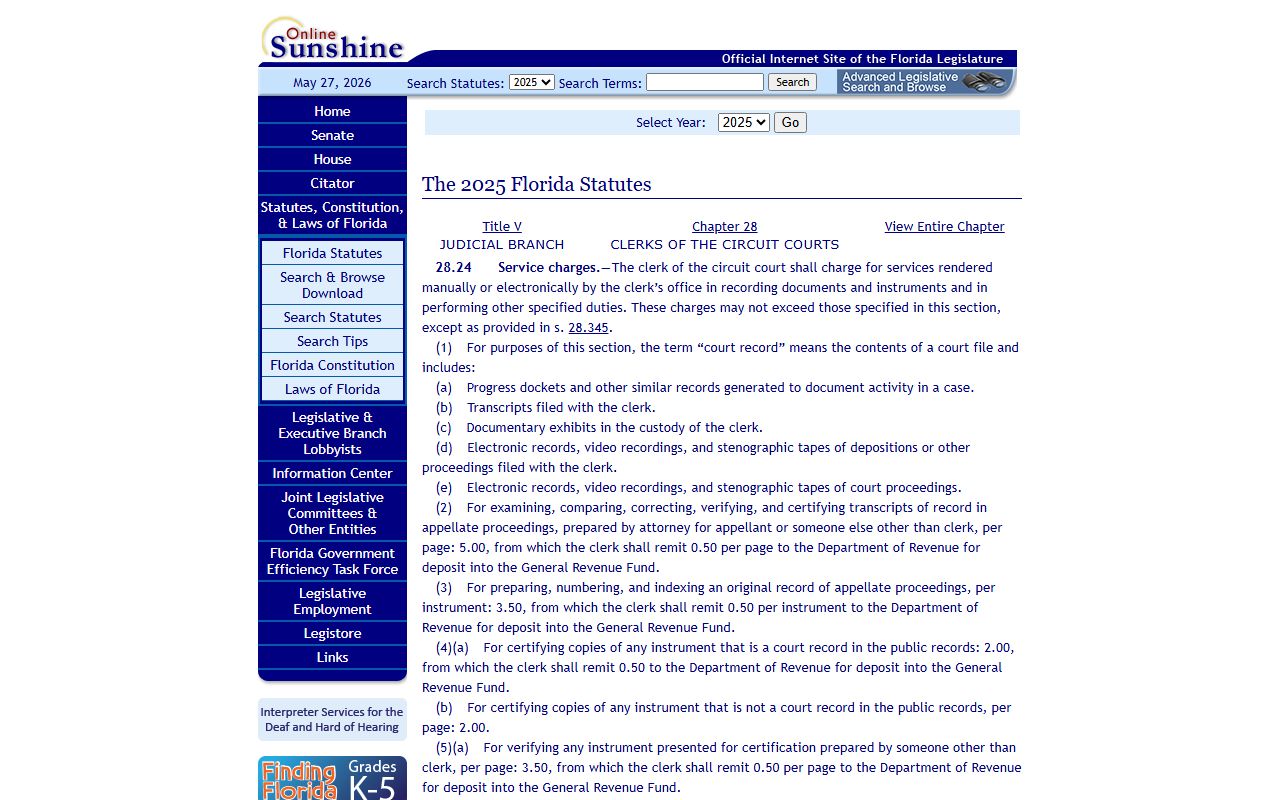
Section 28.24 is the source for the per-page copy and per-document certification fees the Leon County clerk lists on its schedule.
The clerk works from two offices. The main courthouse downtown handles court services, official records, and certified copies. The Northeast Branch handles traffic payments, official records, and marriage services. Both keep the same weekday hours.
Main Courthouse
301 South Monroe Street
Tallahassee, FL 32301
850-577-4000
Official records / marriage: 850-606-4060
Mon-Fri, 8:00 a.m. to 4:30 p.m.
Northeast Branch
1276 Metropolitan Boulevard, Room 101
Tallahassee, FL 32312
850-606-4100
Traffic payments and branch services
Mon-Fri, 8:00 a.m. to 4:30 p.m.