
Probate Division of the Circuit Court
Probate in Leon County runs through the Probate Division of the Circuit Court. The case files are kept by the Leon County Clerk of the Circuit Court and Comptroller. The clerk's probate office defines probate as the legal process that moves the assets of a person who has died to their heirs or beneficiaries. A case opens when an interested person files a petition. That person asks the court to be named personal representative, or asks the court to release property, depending on the size and the facts of the estate.
The Circuit Court for the Second Judicial Circuit sits in Tallahassee and hears these cases. The clerk does the record-keeping. Judges sign the orders. Once a file is open, the clerk tracks every step, from the first petition to the final discharge. Probate is not just for big estates. Small estates and older deaths have their own simpler tracks, which the sections below break down.
What Probate Covers
Probate is broader than just reading a will. The Probate Division handles a range of matters tied to death, property, and a person's legal capacity. Some cases settle an estate. Others protect an adult or a minor who can no longer manage their own affairs. Each type has its own forms, its own fee, and its own rules.
The main matters heard in this division include:
- Wills and their admission to the court.
- Formal administration of an estate.
- Summary administration for smaller or older estates.
- Disposition of personal property without administration.
- Ancillary administration for out-of-state decedents who held property here.
- Guardianship, curatorship, and conservatorship.
- Petitions to determine incapacity.
Trust-related matters can also land in this division. The right path depends on the value of the estate, whether there is a will, and whether anyone needs a guardian. If you are not sure which type fits, the clerk's probate office can point you to the correct petition, though staff cannot give legal advice.
Probate Terms Defined
Probate paperwork uses words you may not run into anywhere else. A few plain definitions help when you read a docket or a file. The list below covers the terms you will see most often in Leon County probate records.
- Testator
- The person who made the will. A testator sets out who gets what after death.
- Executor / Personal Representative
- The person named to settle the estate. Florida courts use the term personal representative for this role.
- Intestate
- Dying without a valid will. State law then decides who inherits.
- Guardian
- A person the court appoints to make decisions for someone who cannot decide for themselves.
- Ward
- The adult or minor the guardian protects and acts for.
- Conservator
- A person named to manage the property of an absent person whose whereabouts are unknown.
- Curator
- A temporary appointee who guards estate assets before a personal representative is named.
Summary Administration
Summary administration is the shorter track. The clerk's probate page says you can file it when the value of the entire estate is $75,000 or less, or when the decedent has been dead for more than two years. That second rule matters. It lets families settle old estates that were never opened, even when the property is worth more than the dollar cap.
This path skips the step of naming a personal representative. Instead, the court can order property released straight to the people entitled to it. That saves time and cost on smaller estates. The official summary administration checklist asks for the probate case number and lists the documents you must attach, such as the petition for summary administration. Gather those papers before you file so the case does not stall.
Note: The two-year rule can open summary administration for an estate over $75,000 when the person has been dead more than two years.
Formal Administration
Formal administration is the full process. It applies when an estate is larger, when there is no quick way to release assets, or when the estate needs a personal representative to act over time. The court appoints that representative and issues letters of administration. Those letters prove the person has legal power to collect assets, pay debts, and hand out what is left.
A formal case runs through several set steps. The representative files an inventory, gives notice to creditors, and publishes that notice so unknown claims can come in. Debts and taxes get paid. Then the representative files a final accounting and asks the court to close the estate and discharge them. Each of these steps shows up on the case docket, so the file paints a full picture of how the estate was handled.
Because the duties are real and the liability is real, formal administration usually involves a lawyer. The attorney rule below explains when that representation is required.
Guardianship and Incapacity
Guardianship and incapacity cases are heard in the same division, but they protect living people, not estates. A guardianship case names someone to make choices for a ward who cannot make them alone. That can be an adult who has lost capacity or a minor who has come into property or a legal claim. The guardian may handle the person, the property, or both.
An incapacity case comes first in many adult matters. Someone files a petition to determine incapacity, and the court reviews medical and other proof before it decides. If the court finds the person cannot manage certain rights, it may then set up a guardianship and assign those rights to a guardian. Guardians of the property file inventories and annual returns so the court can see the money is handled right.
These files often carry extra privacy. Medical details, a person's capacity, and minor matters are sensitive, so parts of these records may not show online even when the case exists.
Probate Filing Fees
The clerk charges set fees to file a probate or guardianship case. These come from Florida Statutes section 28.2401 and Chapter 744 for guardianship matters. The amount you pay depends on the case type and, for guardianship returns, the size of the estate. The table lists the main filing and service fees the clerk publishes for probate and guardianship cases.
| Filing / Service | Fee |
|---|---|
| Formal administration, guardianship, ancillary, curatorship, or conservatorship | $400.00 |
| Summary administration, $1,000 or more | $345.00 |
| Summary administration, under $1,000 | $235.00 |
| Guardianship of the person only | $235.00 |
| Petition for determination of incapacity | $231.00 |
| Disposition of personal property without administration | $231.00 |
| Caveat | $41.00 |
| Exemplified certificate | $7.00 |
| Reopening a case (excludes guardianship and mental health) | $50.00 |
Guardianship cases carry their own audit and return fees. An initial inventory audit above $25,000 costs $85.00. Annual guardianship returns are charged by estate size: $20.00 for estates of $25,000 or less, $85.00 for $25,000 to $100,000, $170.00 for $100,000 to $500,000, and $250.00 for estates over $500,000. The exemplified copy you may attach to letters or foreign filings adds a small charge. Fees can change, so confirm the current amount with the clerk before you file.
Florida sets these probate fees by statute. The state legislature publishes the controlling text online.
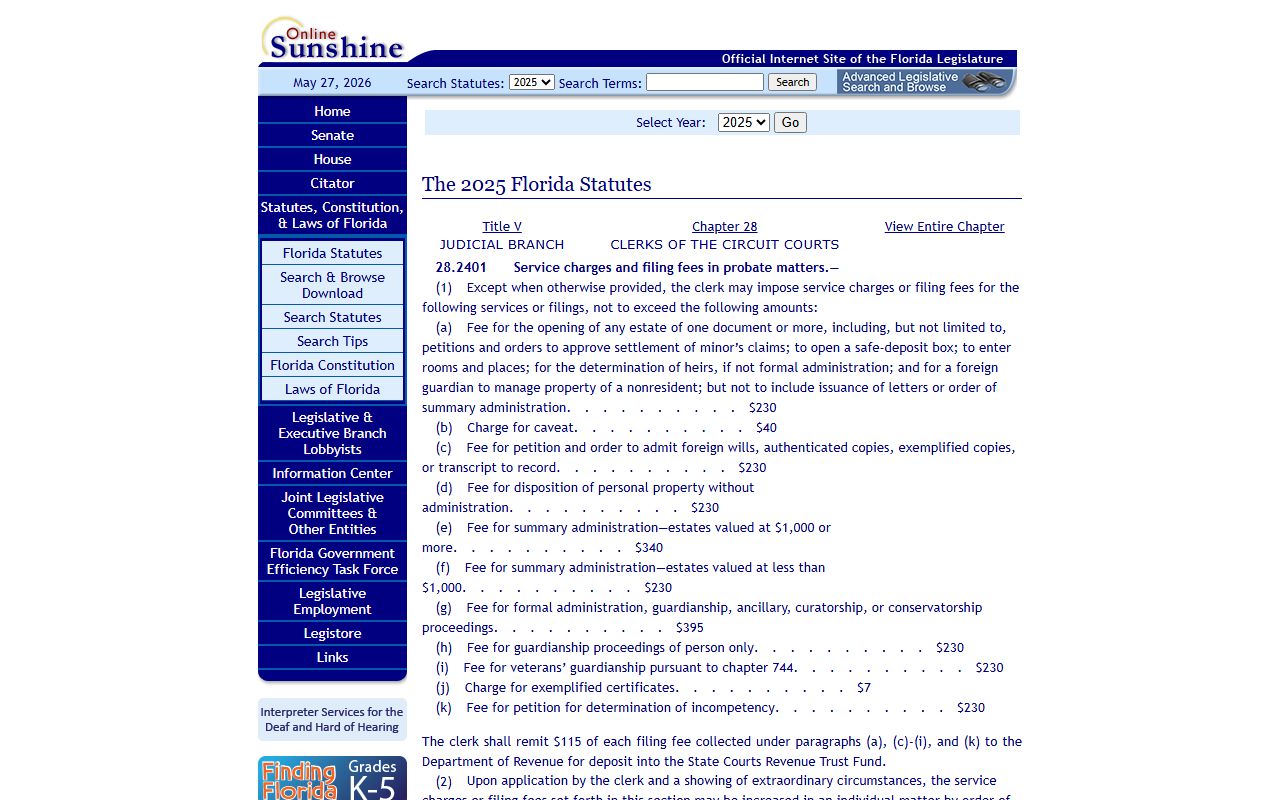
Section 28.2401 is the statute that fixes the filing fees a Leon County estate or guardianship case must pay when it opens.
Attorney Requirement
Florida limits who can run a probate or guardianship case without a lawyer. The clerk's probate page is clear on this point. Every guardian and every personal representative must be represented by an attorney admitted to practice in Florida. There is one carve-out. A personal representative who stays the sole interested person in the estate may proceed without counsel.
This rule trips up many people who try to handle a case on their own. If you are the only heir and the only party with an interest, you may file and act alone. The moment another interested person enters the picture, the rule kicks in and you need a Florida attorney. Guardianship has no such exception, so a guardian always needs a lawyer.
Note: A personal representative can act without a lawyer only while they remain the sole interested person in the estate.
Searching Probate Records
You search Leon County probate records through the same clerk court search used for other case types. Choose probate or guardianship case types where the portal lets you filter. Most case dockets are open, and you can look up a file by the decedent or ward name, or by the exact case number when you have it. The steps below walk through a name search.
- Open the clerk's court search and pick search by name or by case number.
- Set the court type to probate or guardianship if the portal offers that filter.
- Enter the decedent or ward last name, then add a first name or date range to narrow results.
- Open the case summary, then read the progress docket for petitions, letters, inventories, and orders.
- Request a copy or a certified document from the clerk when an image is not shown online.
Registered Secure Web users may reach more. The clerk's Secure Web access can let approved users view Probate (CP) and Guardianship (GA) document images when those images exist. Public web display, on the other hand, may leave out confidential guardianship, mental health, incapacity, minor, and sealed material. So a docket can be visible while a sensitive image stays off the open web.
A probate file holds a set list of fields. The case number, the decedent or ward name, the filing date, and the case type all appear. You will also see the petitioner or personal representative, the attorney, and the judge or division. The docket lists each event in date order: petition, oath, bond, letters, inventory, notice to creditors, proof of publication, orders, final accounting, and discharge. Guardianship files add financial and audit entries. For broader case data across divisions, see court records. To check what other county offices hold, the public records page covers deeds, official records, and more.
Probate Division Contact
The clerk's office downtown is where probate files are kept and where you go for copies, certified documents, or in-person help. Bring a valid photo ID and the case number or party name to speed up a counter request. The card below lists the address, phone, and hours for the clerk that runs the Probate Division records.
Leon County Clerk of the Circuit Court and Comptroller
301 South Monroe Street
Tallahassee, FL 32301
850-577-4000
Mon-Fri, 8:00 a.m. to 4:30 p.m.
The Probate Division is part of the Second Judicial Circuit, which sits in Tallahassee. Records for wills, estates, and guardianships all route through this clerk's office.