
Florida Public Records Law in Leon County
Florida has one of the broadest open-records laws in the country. The framework lives in Chapter 119 of the Florida Statutes, often called the Public Records Act. It starts with section 119.01, which sets the policy that state, county, and city records are open for inspection and copying by any person. The law calls open access a duty of each agency. That duty reaches the Leon County Clerk, the Sheriff, the county commission, and other local bodies.
Any person can ask. You do not have to be a Florida resident, a citizen, or a party to a case. The law does not require you to explain why you want a record. A request can be made in writing or out loud. Still, contact details help, because the office needs a way to reach you and deliver copies.
Inspection, copying, and the fees an agency may charge fall under section 119.07. That section gives the right to look at and copy records and lets agencies charge lawful, set fees for the service. For the Leon County Clerk, those copy and search charges also rest on Chapter 28, which covers clerk service charges in detail.
Rule 2.420 for Judicial Records
Court records sit on a separate track from regular agency records. Florida Rule of General Practice and Judicial Administration 2.420 controls public access to judicial-branch records. The rule creates broad public access but lists the records that stay confidential. It also sets the steps to seal a file or part of one. When the Leon County Clerk acts as part of the judicial branch, access to judicial records under Clerk control follows Rule 2.420, not Chapter 119.
The Clerk's records request page makes this split clear. It separates court records, official records, and other public records. That matters when you ask for something. A motion in a divorce file is a judicial record under Rule 2.420. A recorded deed is an official record. A Sheriff incident report is a general agency record under Chapter 119. Each one may have a different rule for what is open and what gets held back.
Some court details are kept off the web by statute. Section 119.0714 addresses court files, court records, and official records, and it lists protected information that should not show online. So a docket can be visible while a document image stays hidden for review or redaction. The court records page goes deeper on judicial access and how to read a progress docket.
Official Records the Leon County Clerk Maintains
Beyond court files, the Clerk is also the county recorder. Under section 28.222, the clerk of the circuit court records instruments in one general series called Official Records. That single index is where most recorded documents live. It is the first place to look for land and debt records tied to a person or a property.
The reference image below comes from the official Florida Statutes site, which prints the recorder duty in full.
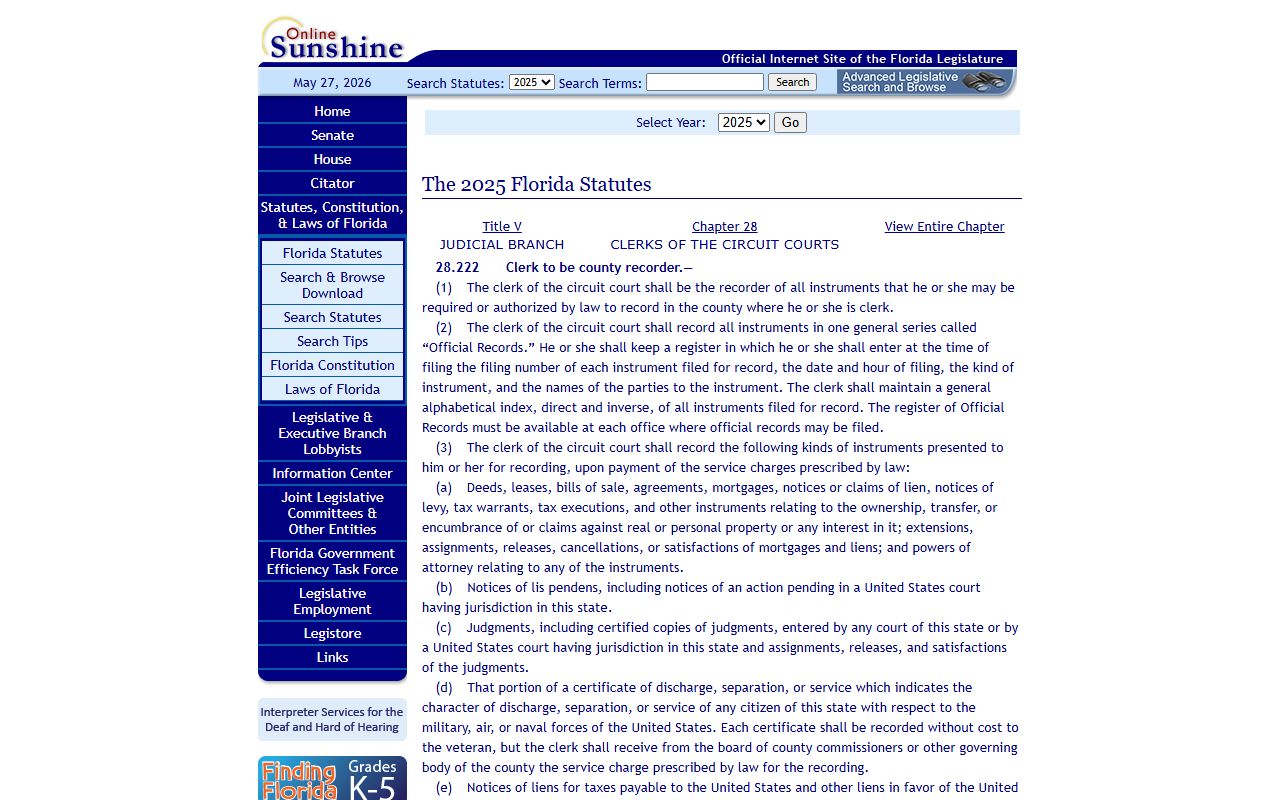
That statute is the legal reason the Leon County Clerk holds deeds, mortgages, and liens in one place rather than scattering them across offices.
The Official Records series holds many document types. The list below names the main ones you can search and order.
- Deeds, mortgages, assignments, leases, and agreements.
- Claims of lien and satisfactions of lien or mortgage.
- Final judgments and other recorded court documents.
- Declarations of domicile and domestic partnership filings.
- Military service documents and certain federal instruments.
Electronic access to these images is not unlimited. Section 28.2221 sets what may appear in online official-record images and indexes. Under those limits, most official-record images recorded after January 1, 1945 are available online, but death certificates and military separation documents are left out of normal online image access. To get those, you contact the Clerk directly. The Clerk of the Circuit Court page covers the recording office and how to order certified copies of official records.
Court Records as Public Records
Most Leon County court records are public. Civil, criminal, family, probate, and traffic files all carry pleadings, orders, and dockets that any person can usually read. Felony cases sit in circuit court. Misdemeanors and traffic sit in county court. The Clerk's online court search reaches both, and most dockets are free to view.
Public access here is the default, not a promise for every file. Section 119.0714 and Rule 2.420 carve out protected court information. Juvenile dependency and delinquency files are restricted. Adoption records need a court order. Sealed and expunged criminal records drop out of public view once a judge signs the order. Mental health and incapacity files carry medical privacy limits.
If you only need a name search or a docket, start with the clerk's free court search. If you need a certified document, order the e-certified version or request a paper copy. For the full search walkthrough and the search-field tables, the court records page lays out each step. Arrest and booking data, which the Sheriff keeps apart from final court disposition, are covered on the criminal records page.
Sheriff and Other Agency Records
The Clerk is not the only office holding public records in Leon County. The Sheriff keeps arrest reports, booking logs, incident reports, and the jail roster. The State Attorney and Public Defender hold case files within their offices. The county commission and city of Tallahassee hold contracts, budgets, meeting minutes, and permits. Each is an agency under Chapter 119 and must respond to a request.
Law-enforcement records get extra handling. Section 119.071 holds many general exemptions, including personal identifying details and law-enforcement information. Active criminal investigation records can be withheld while a case is open. Victim information may be shielded. Some addresses and identifiers are protected for certain workers and crime victims.
Note: Send each request to the office that actually holds the record, since the Clerk cannot release arrest reports or budgets that belong to the Sheriff or the county.
How to File a Public Records Request in Leon County
Filing a request is meant to be simple. Florida law does not require special wording or a set form. You can ask in person, by phone, by mail, or by email. A clear, specific request gets a faster answer, so name the records you want and give a way to reach you. The steps below walk through a standard request to the Leon County Clerk.
- Pick the right office. The Clerk holds court and official records; the Sheriff, county, or city hold their own files.
- Describe the records you want. Add case numbers, book and page, document numbers, party names, or a date range.
- Choose your copy type. Note whether you need a plain copy, a certified copy, or an exemplified certificate.
- Submit the request by mail, email, online, or in person, and include your name and contact details for delivery.
- Wait for the response. The office gathers the records, redacts protected data, and tells you the cost.
- Pay any fees, then receive the records by your chosen delivery method.
For court documents not shown online, the Clerk lets you submit a VOR request by checking the docket entry on the progress docket. For official records and most copies, the in-person counter and the clerk's online services both work. Keep your case number or document number on hand so staff can find the file fast.
Leon County Records Request Form Fields
A request does not need a special format, but a good one carries a few key details. The table lists the fields a Leon County public records request usually includes and how each one is used. Filling these in up front cuts back-and-forth and helps staff price the job.
| Field | Required | Notes |
|---|---|---|
| Requester Name | Yes | Standard request detail used to identify and reach you. |
| Contact Information | Yes | Email, phone, or mailing address needed for delivery; no reason for the request is required. |
| Case Number / Book-Page / Document ID | Recommended | Helps staff locate the court or official record fast. |
| Record Type | Recommended | Court record, official record, or general public record. |
| Party Names | Optional | Used for a name-based search of records. |
| Date or Year Range | Optional | The search fee is charged per year searched. |
| Copy Type | Optional | Plain copy, certified copy, exemplified certificate, or e-certified document if eligible. |
| Delivery Method | Optional | Electronic, mail, or in-person pickup where available. |
Payment details come at the end, once staff confirm the page count and copy type. For paid copies, the search, copy, and certification charges apply. The Clerk does not refund completed certifications, so confirm what you need before you pay.
Response Timelines
Florida law does not set a fixed deadline in days. Instead, Chapter 119 requires an agency to respond within a reasonable time and to acknowledge a request in good faith. A simple request for one known document moves fast. A broad request that needs heavy search and redaction takes longer, and the office may give a time estimate.
An agency cannot drag its feet to avoid the law. If the records exist and are public, they must be produced. If part of a record is exempt, the office redacts that part and releases the rest. You should get a clear answer, not silence.
Copy and Certification Fees in Leon County
The Clerk charges set service fees under section 28.24 of the Florida Statutes. A search fee applies for each year staff search by hand. Copies are priced per page, and certification carries its own charge. The amounts below come from the Clerk's published fee schedule, which controls and can change.
| Item | Amount |
|---|---|
| Search of records, each year searched | $2.00 |
| Plain copy, per page (up to 14 x 8.5 in.) | $1.00 |
| Oversized copy, per page | $5.00 |
| Certifying copies, per document | $2.00 |
| Exemplified certificate | $7.00 |
Pay by cash, check, or credit card at the counter. Online orders may add a small convenience fee. A plain copy or a screenshot is not certified, and it may not be accepted for court, title, or licensing use. When you need proof, order the certified version and review it before you pay.
The right to inspect and copy these records, along with the fees an agency may charge, traces back to the statute shown below on the official Florida Statutes site.
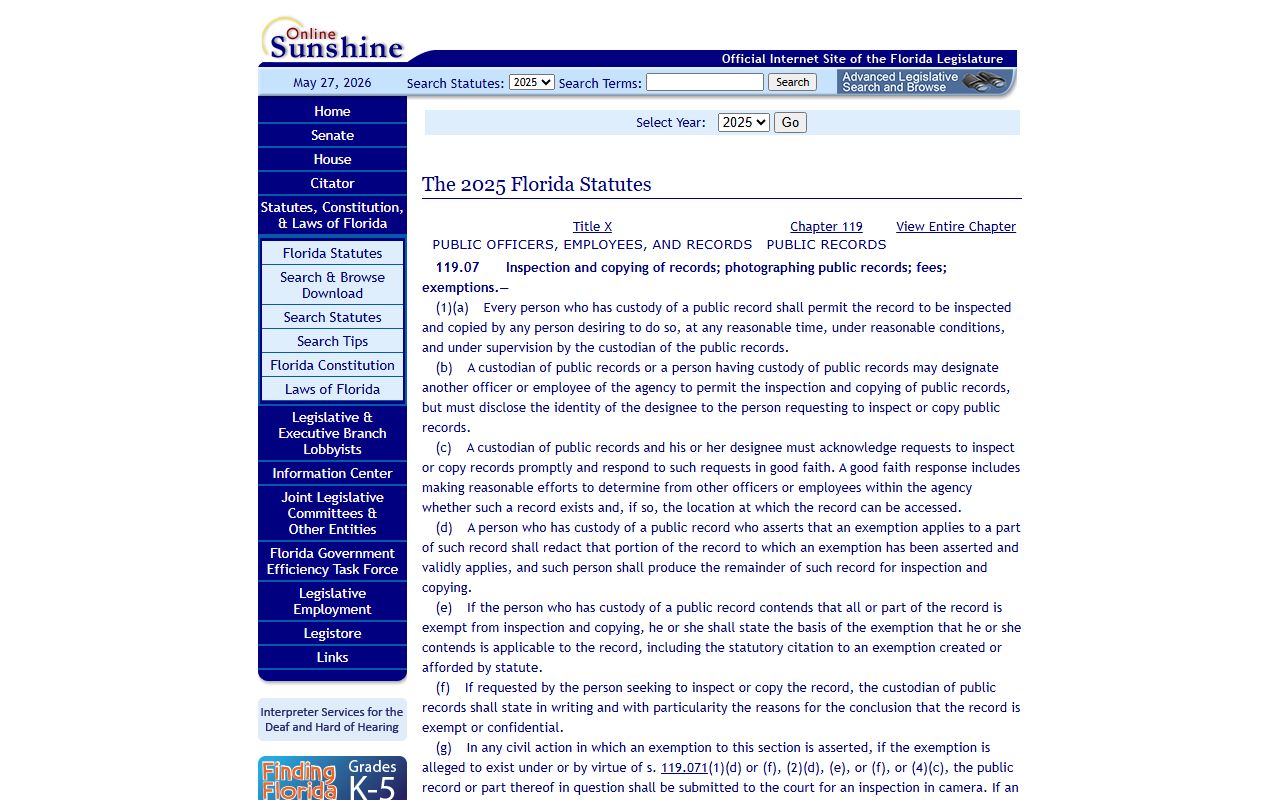
Section 119.07 is the law that lets the Leon County Clerk charge these set amounts while still keeping public records open for inspection.
Exemptions and Redactions
Open by default does not mean open without limit. Florida lists many exemptions, and the broad ones live in section 119.071. These cover personal identifiers, active law-enforcement information, certain protected addresses, and other sensitive data. The court-file exemptions in section 119.0714 add another layer for records the Clerk keeps off the web.
When part of a record is exempt, the office does not withhold the whole file. It redacts the protected part and releases the rest. Common redactions include Social Security numbers, bank and account numbers, minors' names, and victim contact details. Sealed and expunged criminal materials are removed from public access entirely.
The list below shows the categories most often held back or limited in Leon County.
- Juvenile dependency and delinquency files.
- Adoption records, open only by court order.
- Sealed and expunged criminal records.
- Mental health and incapacity proceedings.
- Active criminal investigation information.
- Death certificates and military separation documents in the online official-record images.
If an agency refuses access without a lawful basis, Chapter 119 gives the requester remedies, including an accelerated court hearing and possible attorney-fee recovery. For judicial-branch records, the route runs through Rule 2.420 motions and court orders instead. Related county filings such as estates and guardianships are covered on the probate records page, and marriage and divorce documents on the marriage and divorce records page.