
Arrest Records in Leon County
An arrest record is the file created when an officer takes someone into custody and books them. In Leon County, the Leon County Sheriff's Office handles booking for every law enforcement agency in the county. That means an arrest by the Tallahassee Police Department, the Florida State University Police, or the Sheriff itself all run through the same detention facility. The record made at intake lists the person, the arrest date, the arresting agency, and the charges named at booking. It does not say how the case ends.
That last point matters. An arrest record shows the start of a case, not the result. The charges at booking can change. They can be dropped, reduced, or never filed. Final outcomes sit in the court file, not the arrest log. For the full case history, including pleas, motions, and the judge's ruling, you would use Leon County court records instead. This page leads with the arrest side. Criminal court records are the secondary track.
Arrest data is public in Florida under the state's broad open-records policy. Anyone can look, and you do not need to give a reason.
How to Search Leon County Arrest Records
The fastest way to find a recent arrest is the LCSO inmate search. The Sheriff's online tool lists people currently in the Leon County Detention Facility and shows arrest and booking details for each one. You search by name, then read the result row for the arrest date, the arresting agency, and the charges. The same tool doubles as the jail roster, so a current booking and a current arrest often show up together.
Before you run a search, read the disclaimer. The Sheriff warns that the data is for information only. It is not for legal action or for background checks, and it shows arrest and booking data, not final disposition.
- Open the LCSO inmate search and read the full disclaimer before you continue.
- Enter a last name, which is the best search key. Add a first name to narrow common names.
- Use the ethnicity and gender filters only if you still get too many matches.
- Read the result row for the arrest date, charges, and arresting agency, then open View Detail for more.
The tool only covers people the jail has booked. For an arrest that did not lead to current custody, or for older arrests, you may need a records request to the LCSO Records Division, or a statewide criminal history check through the state. For someone in custody right now, the Leon County inmate records page goes deeper on the jail roster and booking process.
Using the LCSO Inmate Search
The LCSO disclaimer page sets the rules for the search before it shows any data. It states plainly that the results reflect arrest and booking information and not the outcome of a case. You can read that LCSO inmate search disclaimer in full before running a query.
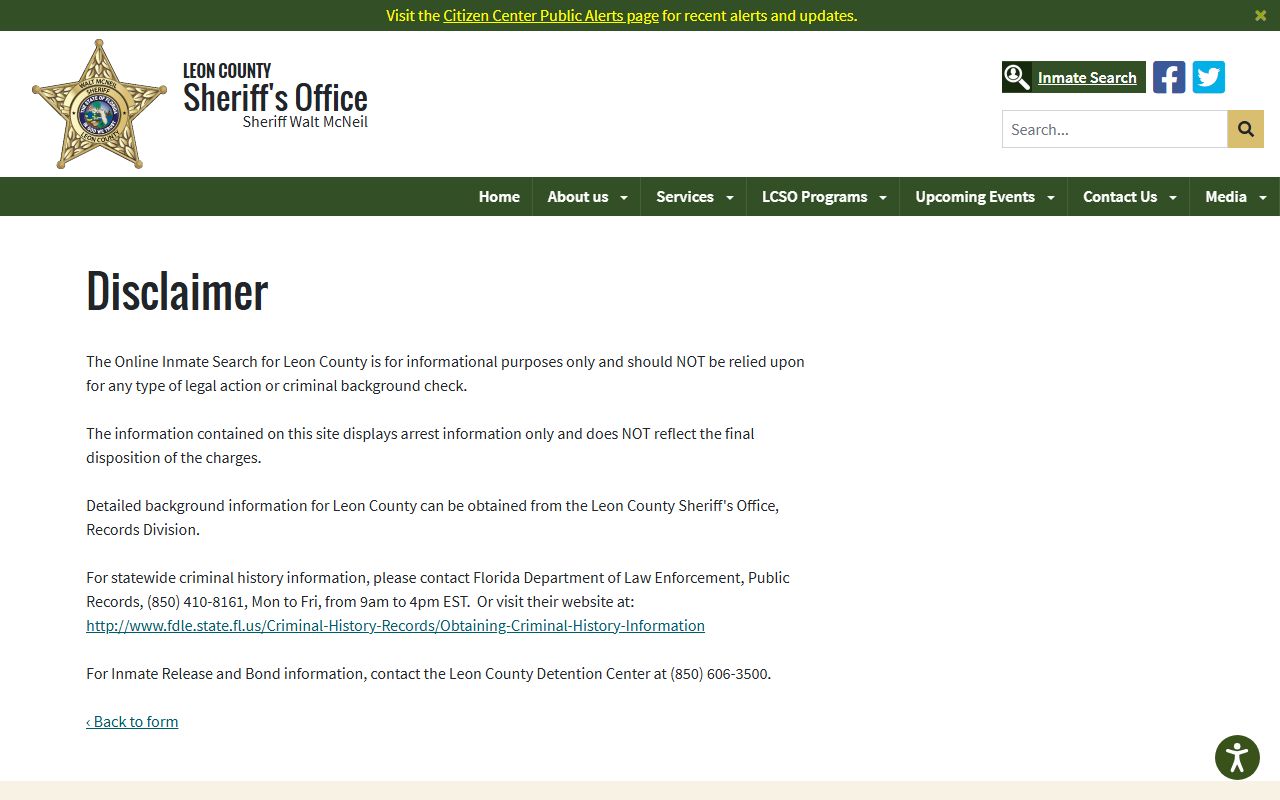
That disclaimer is the reason the search is a good starting point but a poor ending point. The arrest data it shows is real, yet it is not the final word, and the Sheriff says so up front. The search form itself asks for only a few fields. The table below lists what you can enter.
| Field Label | Type | Required | Notes / Format |
|---|---|---|---|
| First Name | Text | Optional | Narrows the search when added. |
| Last Name | Text | Recommended | Best key for a current-custody search. |
| Ethnicity | Dropdown | Optional | White, Black, Asian, American Indian/Alaskan Native. |
| Gender | Radio | Optional | Male, Female, Other. |
| Full Disclaimer | Acknowledgment | Yes | You must accept the disclaimer to use the search. |
A result row returns a photo, the full name and age, the last arrest date, an in-custody indicator, the charges, and the arresting agency. Charges may be listed together in one cell. Booking number, bond amount, and court date are not always shown in the basic row, so open the detail view when you need more.
Arrest Records vs. Criminal Court Records
People often treat these two as one thing. They are not. An arrest record is born at booking and lives with the Sheriff. A criminal court record begins when the State Attorney files charges, and it lives with the Clerk of Court. The arrest is the front door. The court file is the whole house. One tells you a person was taken in. The other tells you what happened next, and how it ended.
| Arrest Record | Criminal Court Record | |
|---|---|---|
| Source | Leon County Sheriff's Office | Clerk of the Circuit Court |
| Created When | At booking and intake | When charges are formally filed |
| Contents | Booking info, arrest date, charges, mugshot, arresting agency | Information, pleas, motions, orders, disposition, sentence |
| Shows Outcome? | No final disposition | Yes, including the final ruling |
| Where to Look | LCSO inmate search | Clerk's court search |
So if the arrest log shows a charge, do not assume that charge stuck. Felonies move to circuit court and misdemeanors to county court, and the case can shift along the way. For the court side, the court records page walks through the Clerk's case search and how to read a docket.
Charges vs. Convictions
An arrest names charges. A charge is an accusation, nothing more. It does not mean a court found the person guilty. The bar to arrest someone is probable cause, which is a much lower test than the proof needed to convict. To convict, the State must prove the case beyond a reasonable doubt, either at trial or through a plea. Many arrests never reach that point.
| Charge | Conviction | |
|---|---|---|
| Stage | Accusation at or after arrest | Verdict or plea in court |
| Decided By | Police and the State Attorney | Judge or jury |
| Burden of Proof | Probable cause | Beyond a reasonable doubt |
| Public Record | Yes, in the arrest file | Yes, in the court file |
Several outcomes can land between the two. The State may drop a case, which the court file marks as nolle prosequi. A judge can dismiss it. In some cases the court withholds adjudication, which means no formal conviction is entered even after a plea, as long as the person meets the set conditions. Each of these reads differently in the court record, and none of it shows on the arrest log alone.
Sealed vs. Expunged Records
Florida lets some people clear a criminal record from public view. There are two tools, and they are not the same. Sealing hides a qualifying record from the public while leaving it in existence. Expunction goes further and orders the record destroyed or treated as if it never existed. Both need statutory eligibility and a signed court order. Neither happens on its own.
| Sealed | Expunged | |
|---|---|---|
| Governing Statute | Florida Statutes 943.059 | Florida Statutes 943.0585 |
| Visibility | Hidden from public view | Destroyed or treated as never existing |
| Law Enforcement Access | Limited statutory access remains | Very limited statutory access |
| Typical Use | Cases where adjudication was withheld | Charges not filed, dropped, dismissed, or acquitted |
Sealing under Florida Statutes section 943.059 usually fits a case where the court withheld a conviction and the person otherwise qualifies. Expunction under section 943.0585 fits cases where charges were never filed, were dropped, were dismissed by the court, or ended in acquittal, subject to the disqualifying offenses in the law. The sealing and expunction steps are covered further down.
Mugshots and Booking Photos in Leon County
A mugshot is the booking photo taken at intake. In the LCSO inmate search, the photo shows in the result row next to the name. For people currently in the Leon County Detention Facility, that image is part of the public arrest data the Sheriff displays. It is the same record set that lists the arrest date and charges.
Two things are worth keeping in mind. First, a booking photo reflects an arrest, not guilt, and the charge tied to it may not survive in court. Second, the photo only appears while the data is in the public search, so an image you saw may drop off once custody status changes or a record is sealed. The booking photo is not a verdict. It is a snapshot from one moment in the process.
Statewide Criminal History Search
The LCSO inmate search only covers Leon County bookings, and mostly current custody at that. For a fuller picture across Florida, the Florida Department of Law Enforcement keeps the statewide criminal history. FDLE runs a fee-based service that returns a person's Florida criminal history record. The Sheriff's own disclaimer points users to FDLE for statewide checks rather than treating the jail roster as a background tool.
You can review the steps and costs on the FDLE criminal history information page before you order a record.
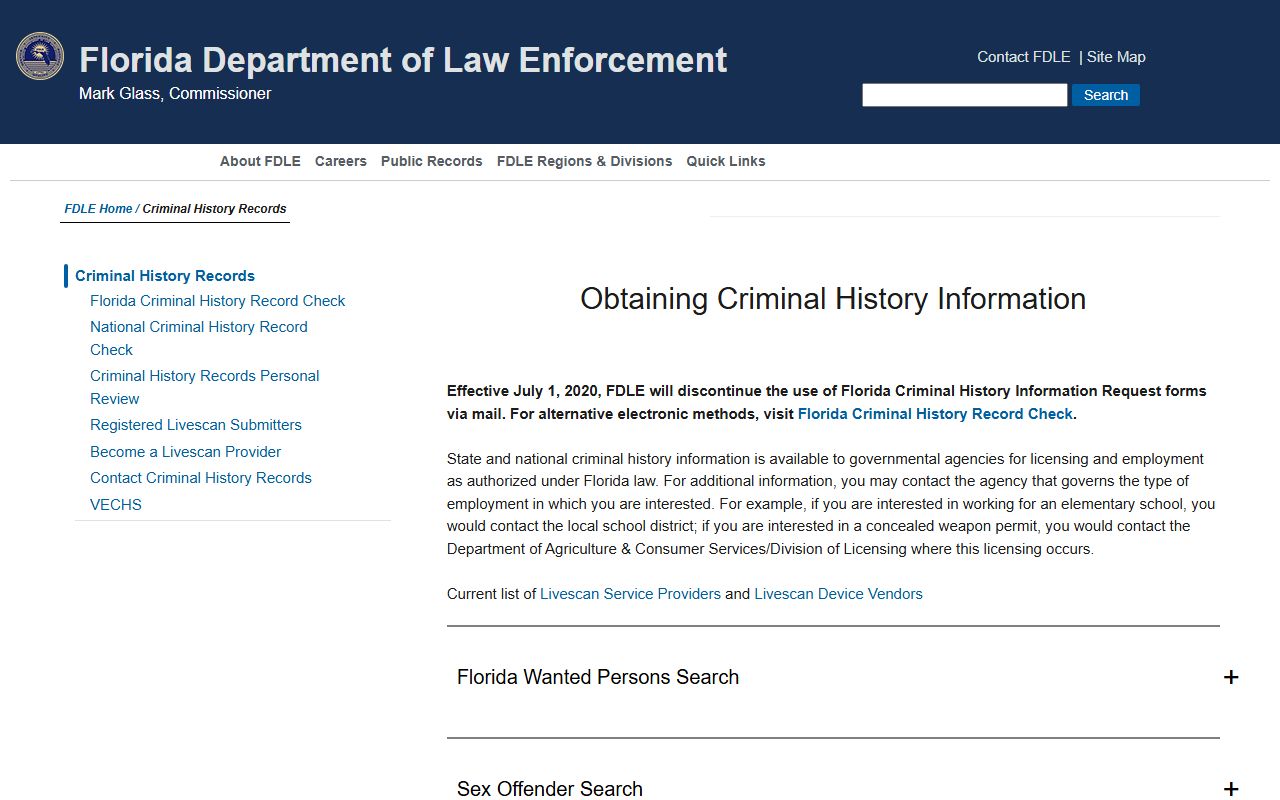
FDLE's record is statewide, which is its real value over a single-county jail search. It is fee-based, so plan on a charge per record. For a certified copy used in a legal matter, FDLE is also the path that connects to the sealing and expunction process, since that workflow needs an FDLE certificate of eligibility.
Sealing or Expunging a Leon County Record
Clearing a record in Leon County runs through the court, and the Clerk has an adult sealing and expunction packet for it. The fee to seal or expunge a criminal record with the Leon Clerk is $66.50. Sealing a civil record costs $42. The criminal process needs an FDLE certificate of eligibility, a petition, a proposed order, proper service, and sometimes a hearing.
The statute that governs expunction spells out who qualifies and how the order works. You can read Florida Statutes section 943.0585 for the full text on court-ordered expunction.
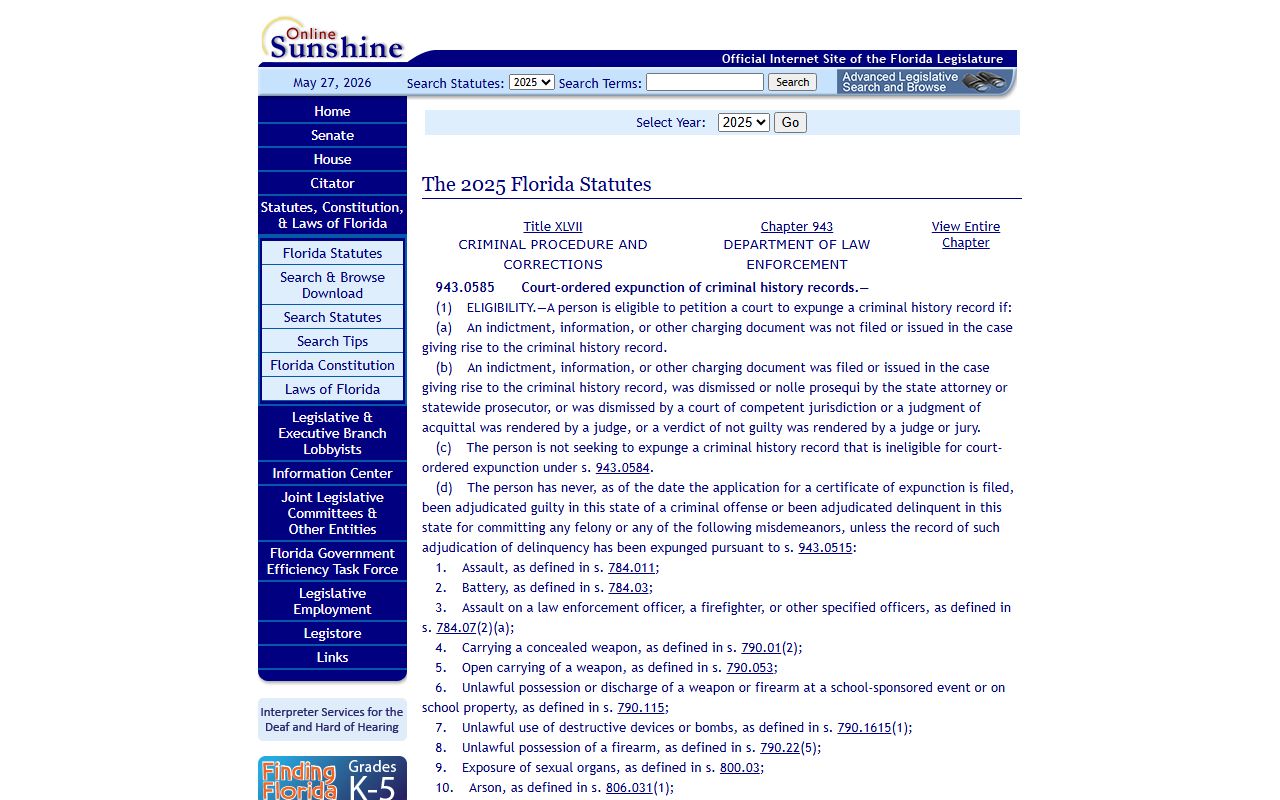
Section 943.0585 is the expunction law, and 943.059 is the sealing law. The basic workflow tracks the same path for most filers.
- Get an FDLE certificate of eligibility where the law requires one.
- Prepare the petition, sworn affidavit, and proposed order from the Clerk's packet.
- File the papers in the Leon County criminal case and pay the $66.50 fee.
- Serve the State Attorney and the named law enforcement agencies, then attend a hearing if one is set.
If the judge grants the order, the Clerk forwards it to the agencies named in the packet. Common reasons for denial include an ineligible offense, a prior sealing or expunction, an adjudication of guilt, open supervision, a missing FDLE certificate, or incomplete service. Even a granted order cannot promise every private copy disappears, since third parties may have copied the data while it was public.
State Attorney and Public Defender
Florida calls the prosecutor the State Attorney, not the District Attorney. Leon County sits in the Second Judicial Circuit, and the State Attorney there is Jack Campbell. The office is the chief prosecuting authority for the circuit, which also covers Franklin, Gadsden, Jefferson, Liberty, and Wakulla counties. Assistant state attorneys decide whether to file the charges named at arrest, and they handle the case from filing through disposition.
On the other side, the Public Defender represents people who face possible jail and cannot afford a lawyer. The Second Circuit Public Defender is Jessica Yeary. Appointment usually happens through court screening and an affidavit of indigency, not by calling for advice. Conflict cases may go to court-appointed counsel instead.
Public Defender, Second Judicial Circuit
Jessica Yeary, Public Defender
301 S. Monroe Street, Suite 401
Tallahassee, FL 32301
850-606-1000
The State Attorney's office is also the contact for victim communication, restitution, and prosecution notices in a Leon County case.
You can see how the office presents its role on the State Attorney, Second Judicial Circuit website.
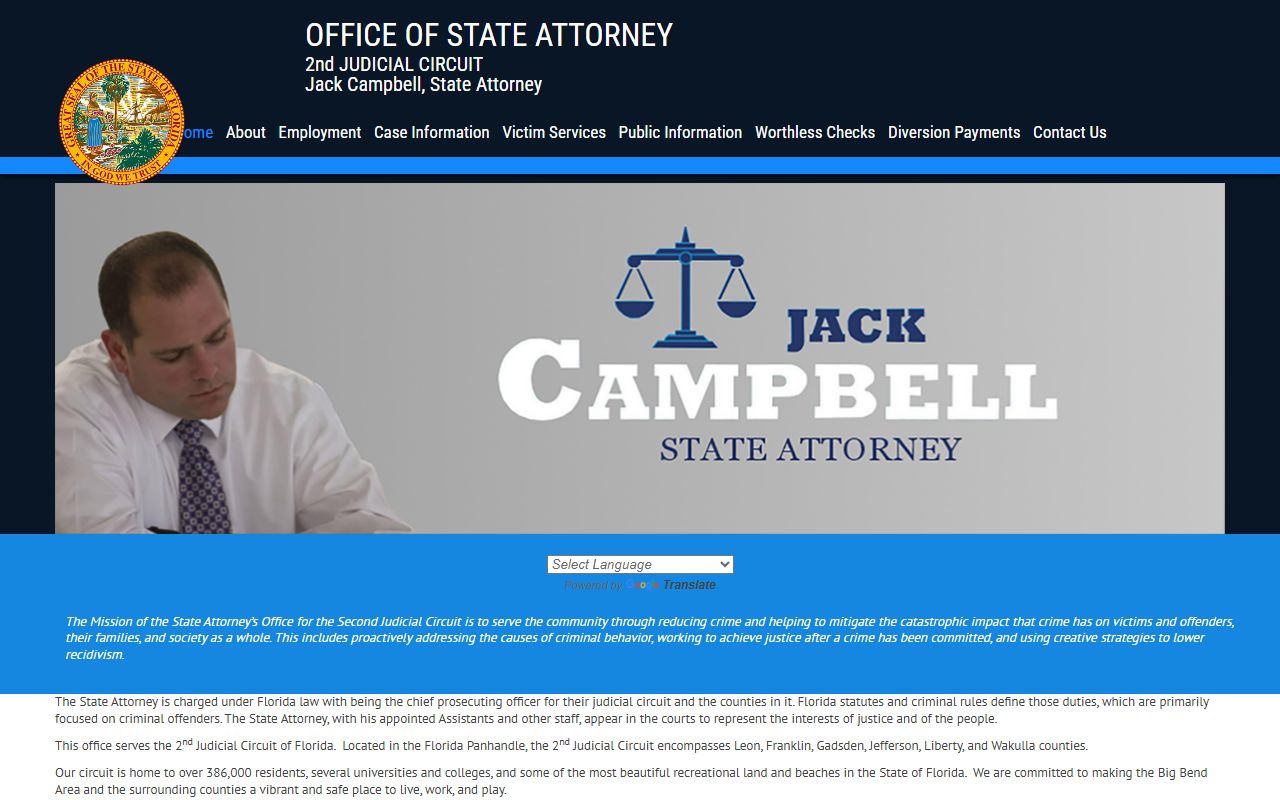
The State Attorney files and prosecutes the charges, while the Public Defender stands in for those who cannot pay for private counsel. Together they move a case from the arrest log to a court disposition.
Background Check Considerations
A casual look at the jail roster is not a background check. The Sheriff says the inmate search is for information only and not for background checks or legal action. A real background check that drives a hiring, housing, credit, or insurance decision falls under the federal Fair Credit Reporting Act, and that law sets strict rules on accuracy, consent, and use. The data here does not meet that bar.
Important: This site is not a consumer reporting agency under the FCRA, and its data may not be used for credit, employment, tenant, insurance, or other FCRA-regulated decisions.
Restricted Arrest and Criminal Records in Leon County
Not every arrest record is open. Florida law and court rules wall off several types. Juvenile delinquency and dependency records are restricted under Chapter 39 and reach only parties, attorneys, agencies, and court-authorized people. Sealed and expunged records drop out of public view once a judge signs the order. Records tied to an active criminal process can be held back from online certification.
Sensitive details are removed even from records that stay public. The list below covers the main categories with limits in Leon County.
- Juvenile delinquency and dependency files under Chapter 39.
- Sealed and expunged criminal records under sections 943.059 and 943.0585.
- Adoption records, which are confidential and need a court order to view.
- Mental health and incapacity matters with protected medical information.
- Victim contact information and protected personal identifiers like Social Security numbers.
If a record you need is restricted, the path is usually a motion under the court access rule, where a judge decides what can be released. The Florida public-records policy is broad, but judicial-record confidentiality runs through Rule 2.420 and the orders in each case.