
Leon County County Court Overview
The County Court is one of two trial courts in Florida. It is the lower of the two. Florida runs a two-tier trial system, with circuit courts for the big cases and county courts for the rest. Every one of the state's 67 counties has a county court. Leon County's county court works out of the Leon County Courthouse in downtown Tallahassee and is part of the Second Judicial Circuit. The same circuit covers Franklin, Gadsden, Jefferson, Liberty, and Wakulla counties.
County court is built for high-volume, lower-stakes matters. It hears misdemeanors, traffic cases, evictions, and small claims, plus civil suits up to the county-court dollar limit. County judges also hold first appearances for people just booked into jail, and they handle juror qualification. The court does not hear felonies, divorce, probate, or large civil disputes. Those belong to the circuit court. Because the county court moves so many cases, it is where most residents have their only contact with the court system, often over a single ticket or a landlord-tenant dispute.
The Leon County Clerk of the Circuit Court and Comptroller keeps the files for both the circuit and county courts. There is no separate county-court clerk. That means a county court record search runs through the same clerk's office and the same online tools used for circuit cases. The split is by court and division, not by clerk. The clerk maintains the dockets, accepts filings, takes traffic payments, and issues certified copies for county court matters from the courthouse on Monroe Street.
County court records carry the same standing as circuit records and are public by default. Florida law treats court files as open unless a statute, a court rule, or a judge's order limits access. A misdemeanor judgment, a small claims final order, or a county civil docket can be viewed online or at the clerk's public terminals. Sealed and confidential matters are the exception, and those stay off the public view.
Leon County County Judges
The Second Judicial Circuit lists five county judges in Leon County, plus one county judge in each of the smaller counties in the circuit. These judges rotate through misdemeanor, traffic, civil, and small claims dockets, and they take turns on the first-appearance calendar. One of the five also serves as the Administrative Judge for the county court division. You can read short biographies for each judge on the circuit's site.
The judge bios on the Second Judicial Circuit county judge page give background on each county judge in Leon County.
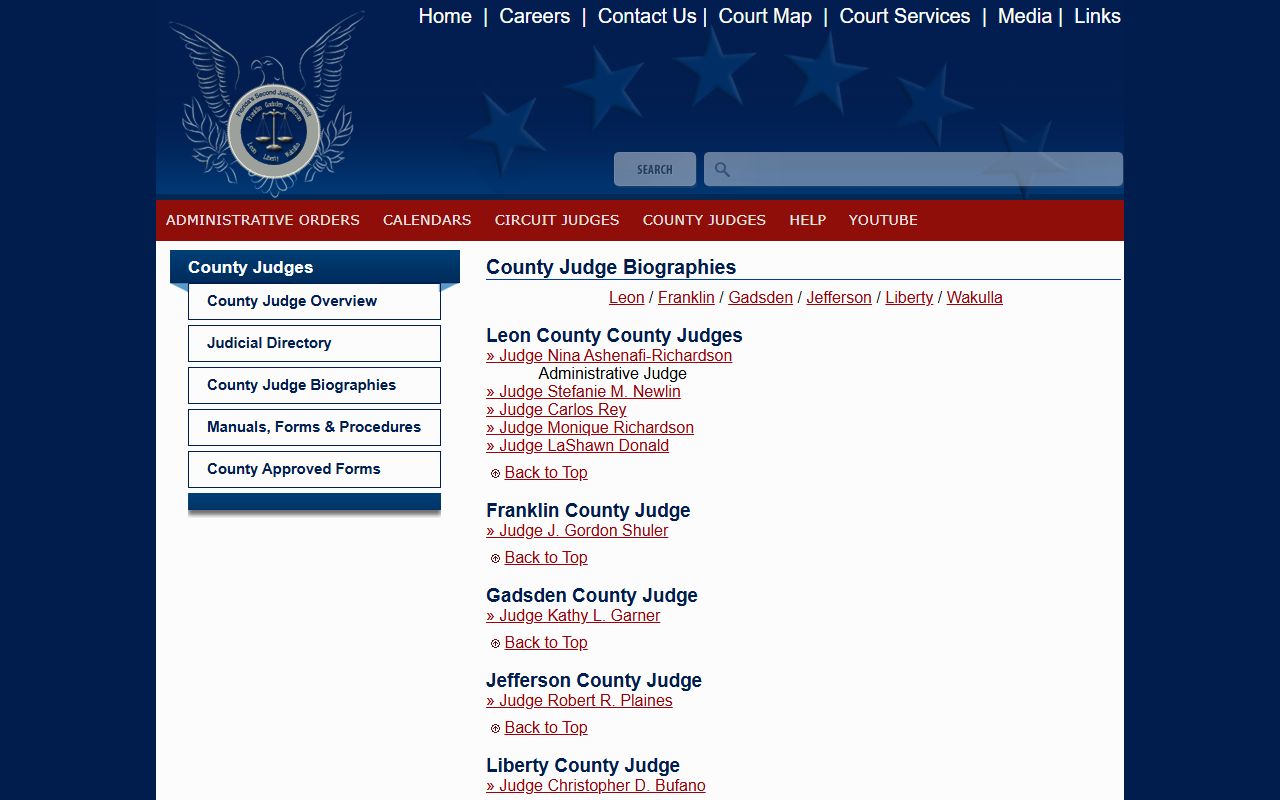
The bio page is helpful when you want to know which judge sits on a case or learn about a judge's career before a hearing. The table below lists the five sitting county judges and their shared circuit contact details.
| Judge | Role | Address / Phone |
|---|---|---|
| Nina Ashenafi-Richardson | County Judge; Administrative Judge | Second Judicial Circuit, 301 S. Monroe St., Tallahassee, FL 32301; 850-606-4401 |
| Stefanie M. Newlin | County Judge | 301 S. Monroe St., Tallahassee, FL 32301; 850-606-4401 |
| Carlos Rey | County Judge | 301 S. Monroe St., Tallahassee, FL 32301; 850-606-4401 |
| Monique Richardson | County Judge | 301 S. Monroe St., Tallahassee, FL 32301; 850-606-4401 |
| LaShawn Donald | County Judge | 301 S. Monroe St., Tallahassee, FL 32301; 850-606-4401 |
All five judges share the same administrative address and main phone line. Case assignments can change, so confirm the assigned judge on your notice of hearing or through the clerk's online case summary.
County Court vs. Circuit Court in Leon County
The split between the two trial courts comes down to case size and case type. County court takes the smaller and simpler matters. Circuit court takes felonies, family law, probate, guardianship, juvenile cases, and the larger civil suits. Civil cases up to $50,000 stay in county court under the current state threshold, and anything above that goes to circuit court. Some older local pages still cite a $30,000 line, but the current statewide figure is $50,000.
The comparison below lays out the main differences.
| County Court | Circuit Court | |
|---|---|---|
| Civil Limit | Up to $50,000 | Over $50,000 |
| Criminal Jurisdiction | Misdemeanors | Felonies |
| Family Cases | No | Yes |
| Probate | No | Yes |
| Traffic and Evictions | Yes | No |
Both courts share the Leon County Courthouse and the same clerk. If you are not sure which court holds a case, search by name across court types first, then read the case summary to see the division. For a full profile of the higher trial court, see the circuit court page.
Case Types the County Court Handles
County court covers a wide range of everyday legal matters. The cases are smaller in dollar value or lower in penalty than circuit cases, but the volume is high. Many residents pass through county court for a traffic citation and never see another court. Below are the main case types the Leon County County Court hears.
- Misdemeanor crimes, such as petty theft, disorderly conduct, and first-time DUI.
- Traffic court, covering moving violations, civil infractions, and many citation disputes.
- Small claims, for money disputes within the small claims dollar limit.
- County civil suits up to $50,000, including contract and property claims.
- Landlord-tenant evictions, which move fast once service is complete.
- First appearances for people booked into the county jail.
- Juror qualification matters tied to the county jury pool.
Records from these cases include the same parts as any court file: a case number, parties, a progress docket, and a disposition. Misdemeanor files may hold arrest affidavits, plea paperwork, and sentences. For citation-specific detail, the traffic court records page covers the traffic side in depth, since county court is where traffic cases live.
How a Case Moves Through the System
A county court case follows a set path. Criminal and civil matters move a little differently, but both end with a judgment and a possible appeal. The flow below shows the common steps. Not every case hits every stage, and many resolve early through a plea, a payment, or a settlement.
Criminal flow: Arrest › First Appearance › Information Filed › Arraignment › Pretrial › Trial › Sentencing › Appeal
Civil flow: Complaint Filed › Answer › Discovery › Mediation › Trial › Judgment › Appeal
Appeals from the county court do not go to the circuit court. They go up to the First District Court of Appeal, which covers Leon County. That court is the intermediate appellate court for the region. A small claims or traffic matter that ends in a final order can be taken there if a party files in time. Most county court cases, though, end at the trial level and never get appealed.
Many county court cases also resolve before trial. A traffic citation can be paid or contested. A small claims dispute often settles or goes to mediation, where the parties stay the decision-makers. A misdemeanor charge may end with a plea at arraignment. The progress docket records each of these steps in date order, so the file shows how the case ended even when there was no full trial.
First Appearances in County Court
A first appearance is the first time a person stands before a judge after an arrest. The county judge reviews the charge, sets or reviews bond, and tells the person their rights. This must happen quickly, usually within 24 hours of booking. County judges in Leon County rotate through this duty.
First appearances for people booked into the Leon County Detention Facility are held in courtroom 2D at the Leon County Courthouse. The schedule depends on the day of the week, as shown below.
| Day | First Appearance Time |
|---|---|
| Monday through Friday | 11:00 a.m. |
| Weekends and holidays | 8:00 a.m. |
These times come from the Leon County Sheriff's Office detention information. Family members who want to watch a first appearance should arrive early and clear courthouse screening. Bring valid photo ID, and confirm prohibited items with the court or sheriff before you go.
Note: First appearance is not a trial; it is an early hearing where the judge addresses charges, bond, and basic rights soon after a booking.
The Second Judicial Circuit
Leon County's county court is administered as part of the Second Judicial Circuit. The circuit groups six counties under one administrative structure: Leon, Franklin, Gadsden, Jefferson, Liberty, and Wakulla. Leon is the largest of the six and holds five of the circuit's county judges. The circuit handles court services that cross both trial courts, such as court interpreting, court reporting, mediation, jury duty, and problem-solving courts.
The county judge roster appears on the circuit's court-system pages alongside the circuit judges. You can confirm the current list and roles there.
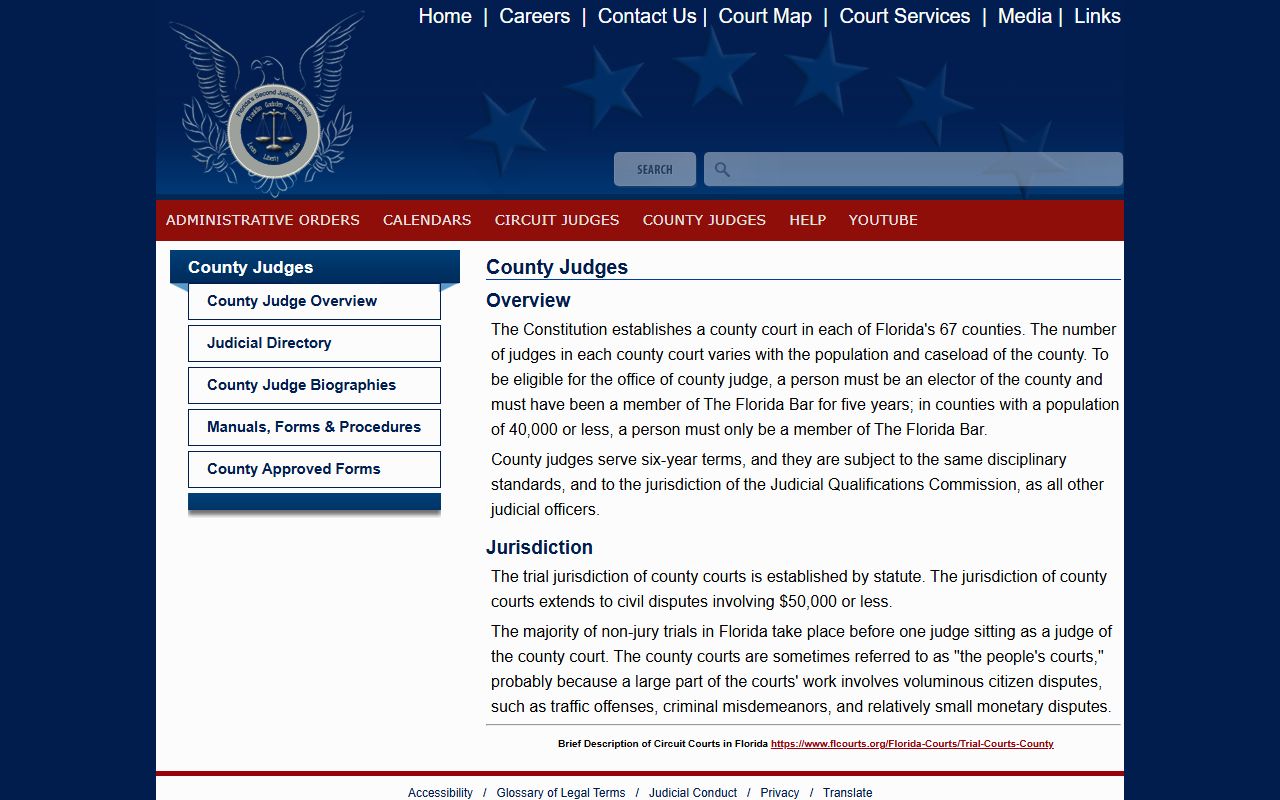
The Second Judicial Circuit county judges page is the official source for who sits on the Leon County county court. The circuit also runs specialty programs that touch county-court defendants, including a mental health court and a Veterans Treatment Court. The circuit's administrative office shares the courthouse address at 301 South Monroe Street.